

 Cooperation between insurance and construction industries has been always difficult and special, and its development has always been connected with complex internal and external processes and phenomena, especially within the former Soviet Union territories. Insurance, being closely linked to the real sectors of economy, is very sensitive to any changes and largely reflects the current condition of the economy.
The global economic crisis' as well as the international sanctions and Russian inner systemic crisis pointed out to the professional and regulatory community that it is the time for qualitative changes instead of implementation of odd and sometimes strange solutions.
For example, the elimination of 1% insurance cost compensation by the state budget for engineering projects financed by the state, pushed back things with insurance to the level of late 90s, when constructors used to deem insurance premium as a sort of obscure additional tax. Obviously, in order to avoid corruption this amendment should have been implemented, but the government has once again chosen the way of interdiction instead of a fine tuning. So called "insurance culture" which has been built up so hardly has broken at once by a new economic reality.
Describing the general situation in the Russian construction industry, it is also important to notice absence of any new system players - companies with or without international capital, which appears anyway a very obvious and expected outcome. Expensive loans and increasing complexity of investment schemes have also negatively affected the domestic investment climate and values of new construction in the country.
Currency devaluation as well as general increase of prices led to increased values of projects' cost estimates. This is especially well observed in terms of purchase of foreign expensive equipment, materials and technologies, in particular in such industries as power generation, oil and gas, chemicals, high tech etc. The cost of construction/erection works of any complexity also is constantly increasing.
The country is already starting to recall a bit forgotten practice of "saving on pencils". So, for example, customers and contractors are beginning to save money on a variety of additional expenses, such as insurance, secondary site equipment, security, projecting and engineering research etc. Certainly, this behavior is negatively affecting the quality of works and safety, leading to various dangerous incidents.
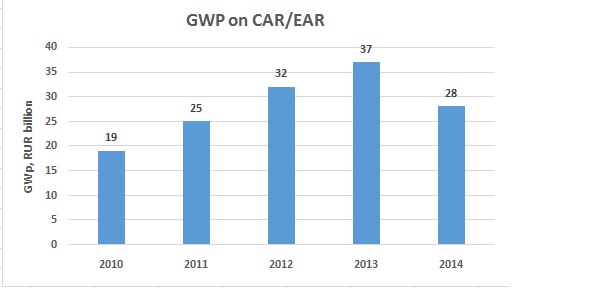
The dynamics of written insurance premium (engineering insurance) throughout the recent period logically reflects some negative changes in the country's economy. Yet, despite the significant fall of results in the past year, market expects some growth of premium due to different market and sectoral factors.
In Russia, up to 80% of the insurable engineering risks are still represented by construction projects funded by the state. In this regard it's important to mention a significant concentration of engineering insurance business among theTOP-5 insurance companies in Russia which write up to 80% of engineering insurance premium.
The engineering insurance market average loss ratio remains at a relatively low level of 20-30%, especially as compared to the European average loss ratio of 70-80%. The main reasons for this situation are:
- contractors do not report small losses in order to avoid reputational risk, suspension of works, further investigation and possible changes to a project
- low awareness of an insurance protection mechanism
- relatively low exposure to the risks of natural disasters in Russia
- complicated and unclear procedures of a loss settlement
Technically complicated, exposed and expensive projects are necessarily insured - this is undoubtedly a positive fact. Examples of such projects are construction of LNG complex" Yamal", renovation programs of such market pivotal companies as RosNeft, Gazprom, RusHydro, RosSeti, NLMK etc.
Separately, it is necessary to outline the large state budgeted projects - majorly a construction (or renovation) of large-scale infrastructural and social objects. Famous examples are the expansion of Moscow and St. Petersburg metro, federal highways, complex reconstruction of railway objects, stadiums for the upcoming football WC 2018 etc. All in all the volume of these investments remains at a quite high level. Insurance of such projects is itself very specific, and after the interdiction to compensate additional costs for insurance it became much more unclear.
A good example of contemporary realities is the insurance of the Kerch Strait Bridge to Crimea. The issues regarding the reinsurance of its construction under international sanctions have been extremely difficult and still are not fully resolved although the construction works are being actively conducted at full capacity.
Construction of medium size objects (TCV RUB 50-2,000 million) is now experiencing a hard time. Private projects are insured mainly in case there are international investors or huge companies with well-established risk management system. Projects designed for obtaining large profits (such as large shopping malls) continue to be insured with quite an extensive coverage, including defects, ALOP, long maintenance cover, various add-ons etc.
Almost all "small" construction projects (TCV lower than RUB 50 million) are not insured, and in case of a possible damage there is the contractor to bear risk exposure as well as various extra costs. For insurance companies this particular segment is not that worth a very active development as high-intensive and very competitive marketing and sales don't provide a proper return because of a higher loss ratio and a relative low volume of premium income.
Reinsurance of engineering risks developed during recent years has proved to be quite effective as from the very beginning it was supported by an utilization of high-tech western reinsurance technologies, as well as the experience and capacities of the leading international reinsurers.
The main tendencies in the CAR/EAR reinsurance are nowadays:
- Aspiring to a cut or limited coverage and higher deductibles (priorities) in order to fit reinsurance premium budget.
- On the contrary to this - an implementation of an excessively wide coverage targeted to a further maximum reinsurance premium reduction (step by step in a process of long negotiations) and exclusion of odd items.
- Reinsurance of bottom layers (deductibles, priorities, sub-layers - the most dangerous zones) on domestic and international low-rated markets.
- Quotation of risks among a substantial number of reinsurers in order to obtain the most competitive T&C for further placement "without a Leader" as based on differential conditions and prices.
- Fronting and/or further reinsurance of substantial shares which were written by high-rated reinsurers. Goal is to circumvent an Insured's requirements regarding reinsurers' financial strength; to return the risk to a domestic market which provides low prices and flexible solutions; to save reinsurance premium and get an additional (broker's) commission.
- More active involvement of various professionals to the process of CAR/EAR reinsurance: surveyors, engineering experts, loss adjusters, lawyers, financial analysts etc.
However, there is a reason to believe that now it is the time to begin the process of the existing regulatory framework optimization - namely to create a mechanism for an effective insurance of state budgeting projects, contractors' liability, optimization of operation and insurance of Self-Regulatory Organizations. We are sure that overcoming this difficult period and combining it with methodological and resource development will strengthen and increase the effectiveness of property and engineering risks insurance in Russia.
Denis NIKOLAYTSEV, Deputy Head of Moscow Representative Office, BARENTS Re
21612 views

